Why We're Investing in Western Australia's Blue Economy
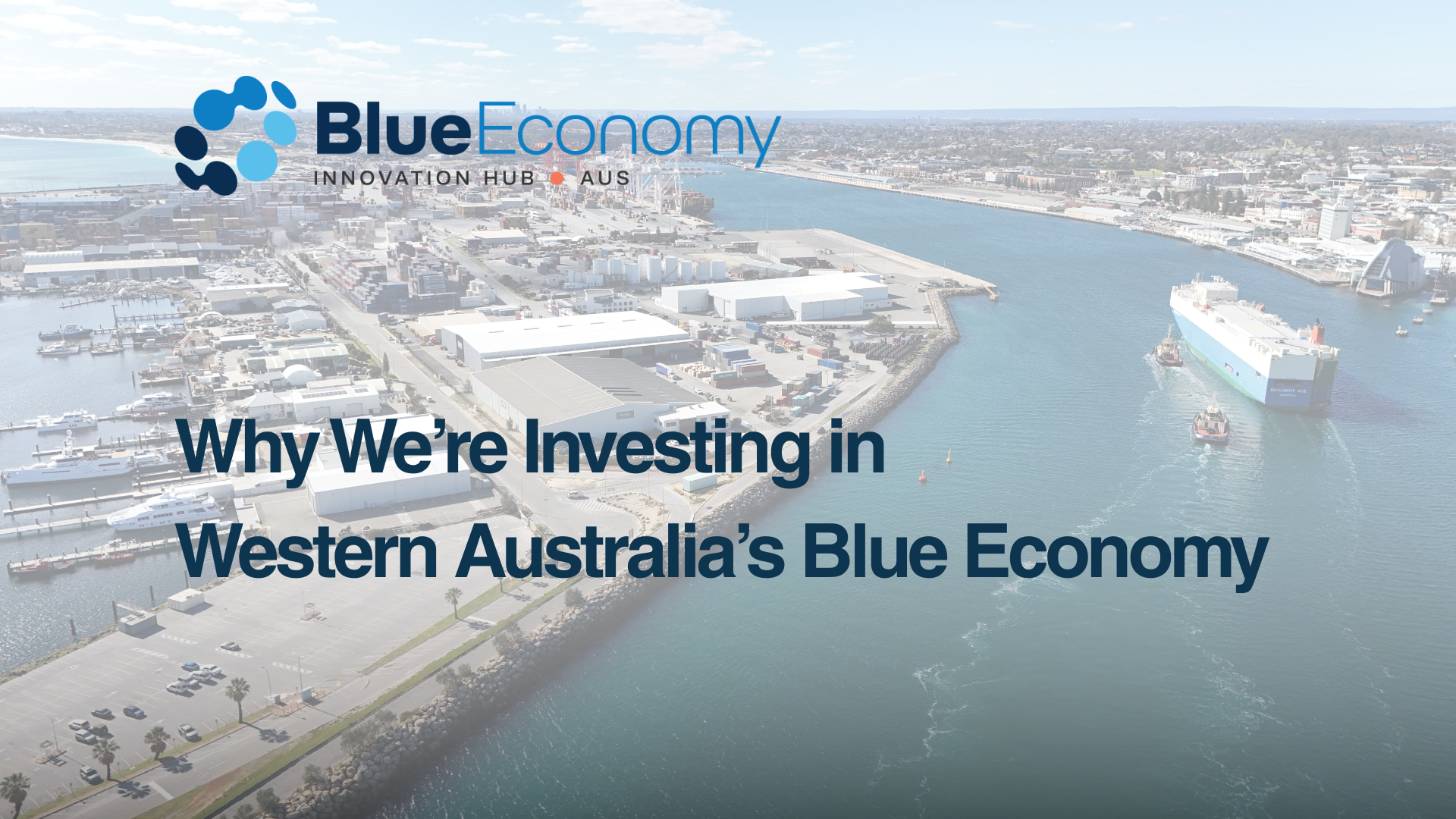
Western Australia is sitting on some of the most under-capitalised commercial ocean innovation opportunities in the world, which may come as a surprise to those who are familiar with capitalisation of the state’s other sectors, like mining, energy, agriculture and life sciences!
That WA’s blue economy is a relatively undervalued locally and globally is the thesis behind the WA Blue Economy Innovation Platform, and it's worth sharing some of our thinking.
The numbers make the case before I do
WA holds 35% of Australia's coastline. The ocean, including the EEZ, makes up 49% of the state's total area, and 90% of Western Australians live within 10km of it. Ocean-related industries already account for roughly a quarter of WA's GDP, and the state contributes close to half of Australia's entire blue economy (AIMS Index of Marine Industry, 2025). Most of that today is oil and gas. The opportunity in front of us is what gets built on top of that base as the mix shifts.
This isn't a story I'm telling in isolation. It's playing out globally, right now, and the capital is starting to follow. Bluetech and ocean observation is now the fastest-growing blue economy sub-sector in venture terms: funding is up more than twentyfold over three years to around US$4 billion in 2025, producing five unicorns along the way. In Europe, dedicated "blue funds" are no longer a niche sitting beside mainstream venture capital, private equity and corporate-backed money. The European Commission now tracks 159 private funds active in the blue economy across the EU alone. The signal is consistent: ocean industries are moving from impact-adjacent curiosity to a genuine institutional asset class. WA has the physical and industrial base to be a real participant in that shift, but participation has to be actively built, not assumed. This is at least partially, frankly, because the State is: a) geographically extremely isolated, and b) the narrative presented by and about WA is dominated by other industries.
WA has done this before, just not necessarily strategically
WA doesn't need to invent ocean innovation credibility. It needs to organise what already exists. Since the 1980s, WA researchers and entrepreneurs have produced a body of world-leading ocean hardware and software: Austal's aluminium catamarans, Total Marine Technology's subsea robotics, Nexxis's inspection robots, Blue Ocean's gliders, Carnegie Clean Energy's wave energy generators, and L3Harris's communications technology, among others spanning coastal infrastructure, offshore operations and desalination. A new generation is now building on that foundation: Greenroom Robotics's software, Hyperion Systems's advanced manufacturing, Enautic's waveflyer, and Uluu's biomaterials.
That's a real comparative advantage in offshore construction and decommissioning, subsea Inspection, Maintenance, and Repair (IMR), maritime, coastal engineering, marine sustainment, bioinnovation and decarbonisation. But it has been organic, not strategic: pockets of world-class capability that grew up around individual companies and research groups rather than a connected pipeline driven as a government or investor priority. Some of WA's strongest ocean ventures have already scaled their technology and secured significant investment, which says as much about the depth of this ecosystem as any new entrant could.
Meanwhile, industries are shifting underneath us: offshore energy production and processing is changing shape, and advanced maritime and shipbuilding sustainment capability is emerging as a major growth pillar for the state in its own right and some of the world’s largest coastal infrastructure and marine regeneration projects are in planning.
The transition is happening whether or not there's a platform underneath it. The question is who captures the value or exports it.
Other regions have already built the soft infrastructure WA was missing
This is where the international comparison earns its keep: not as inspiration, but as a warning about pace. Canada's Ocean Supercluster now coordinates a community of roughly 1,000 members co-investing in more than 150 projects, and has helped launch close to 300 new ocean companies over the past five years through deliberate ecosystem investment.
In Seattle, Washington Maritime Blue is opening a Maritime Innovation Center with the Port of Seattle in late 2026: seven Class A waterfront offices purpose-built to concentrate founders, capital and port infrastructure in one place. Spain's BlueTechPort is doing the equivalent around its own port assets. None of these regions have a natural advantage over WA in coastline, industrial base or technical depth.
What they have is a coordinated front door for capital and commercialisation support, one built to grow local capability and bring in global talent and ventures at the same time, that WA does not yet have at scale.
That's the gap the WA Blue Economy Innovation Platform is built to close: not another grant program, but an end-to-end pipeline:
Gravity handles early diagnosis and incubation support,
Propel handles acceleration,
Dock is the landing pad for import and export, bringing proven global ventures and talent into WA alongside what's grown here, and
Growth is the community, events, showcases and connectivity that enables organic opportunities.
The goal isn't only to organise capability that exists across WA's ocean sectors. It's to give it the same structured, investor-facing pathway that Nova Scotia, Seattle and Barcelona have built for theirs, and to make WA an obvious and accessible destination for ocean innovators and investors from anywhere.
Why this matters to me, specifically
I've spent 15+ years in innovation and commercialisation program design, most of it working out how to connect deep technical capability with the commercial and investment discipline it needs to scale.
The pattern I keep seeing in WA's ocean sector is talent and IP that's competitive on a global stage, sitting several steps away from the capital and commercialisation infrastructure that would let it compound. It's a pipeline and connectivity problem, not a talent or capital one. The fix is building the connections that bring capital partners from the world's other major investment hubs to WA, so the region can compete for global ocean talent and markets on the same terms those hubs already do.
WA leads the world in ports and mining because someone made that kind of deliberate investment before.
Propel is my piece of it — the acceleration stage of the pipeline and applications for Cohort 1 are open now.
If you're building in marine, maritime or naval technology (e.g. autonomous and unmanned systems, underwater and subsea technologies, port and coastal infrastructure, oceanography and environmental monitoring, propulsion and energy systems, AI, data and decision support, or logistics, sustainment and supply chain) Propel is built for you, wherever in the world you're building it.
If you're a capital partner watching the sector from the sidelines, this is the moment the region moves from organic to organised, and the earlier you're in the room, the more of that upside is yours to shape.